Angela Melitopoulos: Matri-Linear B
Matri-Linear B is an audiovisual art research project about the forms of expression and functions of the earth’s surface, shown as a video installation within the context of the larger research project Contemporary Prehistories – Dissident Goddesses.
Linear B was one of the earliest scripts, first used to record inventories of goods. The combined words of the title, Matri-Linear B, imply a potential for deviating from an economic register that defines economic growth. Prehistory, archaeology and social technologies in matri-linear societies are contrasted with subject-object relations in imaging technologies that capture the surface of the earth/landscapes, and what lies beneath. Matri-linear B calls for matrixial registers through cultures of the relationship with the environment (earth).
Dynamic scaling systems evolve within a 4-channel video and 16-channel audio-installation. Matri-Linear B works with cine(so)matic stories that tell of the knowledge embedded in the earth, in the landscape, on the earth’s surface. Around 7 sections map out time-based, multi-part depictions of landscape. Tracing remarkable impressions of the earth, the narrative conveys a feeling of revelation. The landscape becomes a container of knowledge, navigating from visual space into an archaeological and sociological, sequential narrative. Various folds, representing logics between detail and panorama, explain political systems that exert forces between endogamy and exogamy from prehistory through to the present day.
The project is based on the archaeological discoveries of the Venus sculptures at the beginning of the 20th century, in particular the Venus of Willendorf in Lower Austria. Meticulous research by archaeologists from Lower Austria has deconstructed restrictive 19th- and 20th-century perspectives on the role of women, taking as a guide these prehistoric, female sculptures in one of the oldest prehistoric societies in Europe. Rejecting the interpretation of assigned gender roles, this most recent scientific debate qualifies archaeology as a pivotal practice that enables us to take a more distanced view of the turmoil of a contemporary debate on modernity.
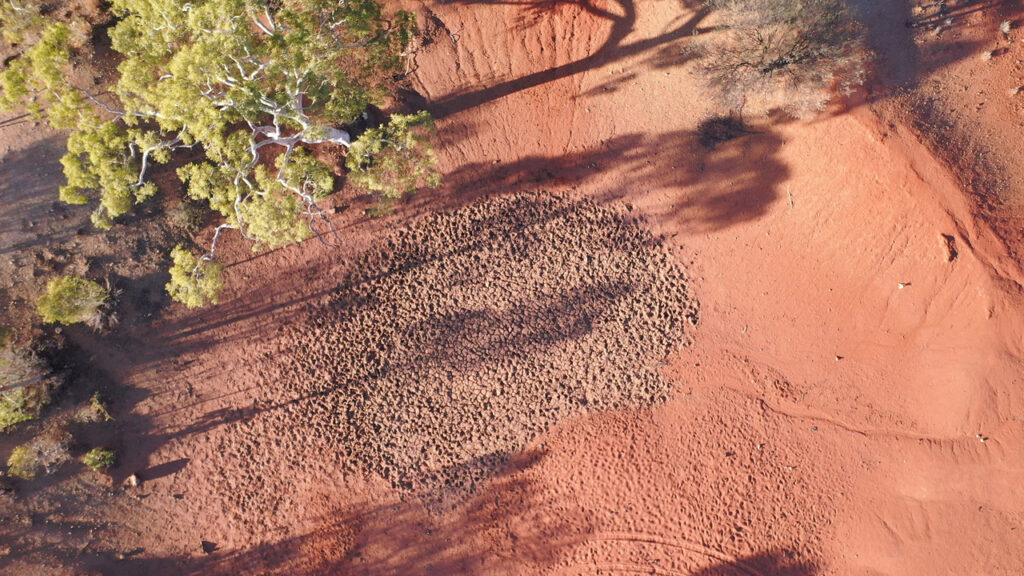
The second section explores the function of painting and art for Indigenous Australians. A third section examines the half-nomadic cultures of the Zomia highlands in contrast to the arable rice systems, as described by James C. Schott in his book “The Art of not Being Governed”. By moving into isolation in the highlands, a number of tribes managed to defy economic and state development strategies. There, we still find genuinely matri-linear economies that are still in operation, for example, the Mro people…
In contrast to these landscapes, we find ruptures.
Used to scan the surface of the earth, today’s high-tech imaging technologies represent a significant point of disturbance. These technologies are key for archaeology, but also for today’s mining industry, which is becoming the core of an unsocial, destructive political system. The violent technical and scientific interpretation of the earth using satellite data makes a contested area doomed to failure, to be exploited by a modernist, capitalist, patriarchal understanding of the economy, based on unequal valuations and the notion of the victim.
In Matri-Linear B, the earth’s surface is seen as a living expression in itself; a thin layer between the inner earth and the outer cosmos on human activity is depicted as a circular movement from the biosphere to the earth’s surface, its humus, its geology and agricultural practices (archaeology layers of time tools culture nutrition climate climate change transformation mobility capture connectivity trade routes gender relations).
The movement proposed is a fictional thesis that critically questions historical narratives of modernity, which require physical alienation for the constitution of a theology separating human from humus. In fact, the body is an effective tool for the production of knowledge between earth and human.
By contrast, this somatic knowledge has been disempowered by perception technologies that use framing, scaling, and a geometric, fixed interpretation. Scientific methods have pushed out the old, unifying methods in visual art – but also in agricultural practices, and in the cultural understanding of multiperspectivism.
These war frameworks represent the decontextualization of a moral interpretation of modern belief systems, the analysis of the “war frameworks” of the hypercapitalist extraction of the earth and the common.